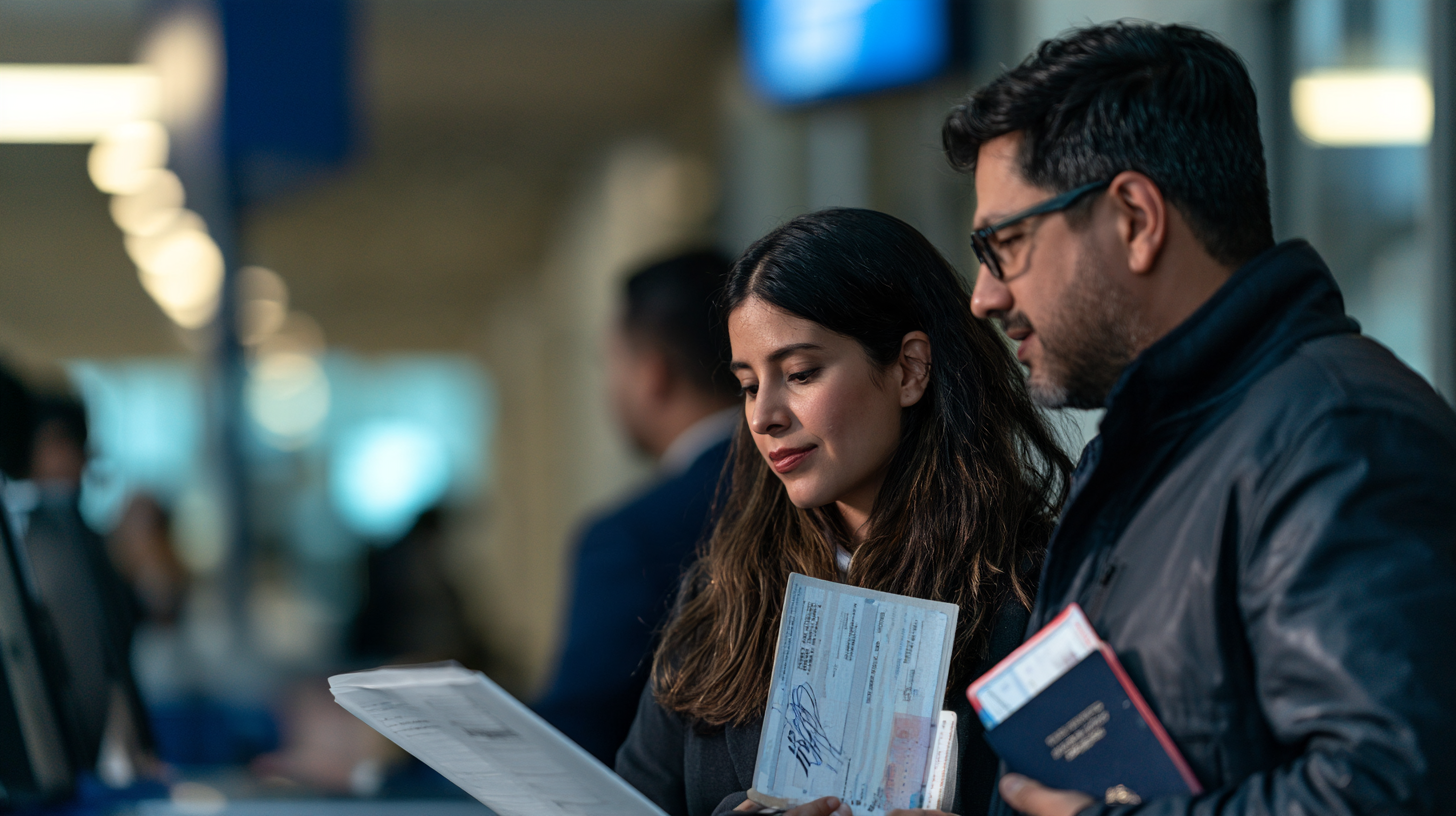
A **J-1 Exchange Visitor can often travel outside the United States while the program remains active**, but returning depends on valid program records, travel documents, and applicable visa requirements.
Form DS-2019 alone does not guarantee reentry, and even a valid J visa does not guarantee admission. U.S. Customs and Border Protection – CBP makes the final admission decision at the port of entry.
Before international travel, check:
**Passport + J Visa + DS-2019 + Travel Validation + SEVIS + Program Dates**
## J-1 visa vs. J-1 status
These are different concepts.
A **J-1 visa stamp** is principally a travel document used to travel to a U.S. port of entry and request admission.
Your **authorized stay in the United States** is determined by DHS through your admission record and applicable J program rules.
As a result, a visa stamp can expire while a participant remains lawfully in the United States.
The visa expiration date alone does not determine when a participant must leave.
### Important September 2026 change
Through September 14, 2026, J admission has generally operated under the Duration of Status – D/S framework.
A DHS final rule scheduled to take effect **September 15, 2026** replaces D/S with fixed admission periods for F and J nonimmigrants.
After implementation, participants entering or reentering under the new framework should pay particular attention to the **I-94 Admit Until Date** rather than relying on the visa expiration date or DS-2019 alone to determine authorized stay.
## What documents are normally needed for reentry?
A continuing J-1 traveler should generally have:
- A valid passport.
- A valid J-1 visa when a visa is required for reentry.
- A current Form DS-2019.
- A valid travel validation on DS-2019.
- A valid program and SEVIS record.
- Any additional program documentation recommended by the Sponsor.
Keep DS-2019 in carry-on baggage.
Supporting information concerning the Sponsor or Host Organization may also be useful depending on the program.
## What is a DS-2019 travel signature?
Form DS-2019 contains a section for:
**Travel Validation by Responsible Officer**
The Sponsor uses this section to confirm that the participant remains in good standing with the exchange program for purposes of international travel and readmission.
Participants should check the validation before leaving the United States.
## Who can sign DS-2019 for travel?
The travel validation is completed by an authorized Sponsor official:
- Responsible Officer – RO.
- Alternate Responsible Officer – ARO.
An employer, professor, Host Organization, or Host Family cannot substitute for the Sponsor merely because it supervises the participant's day-to-day activity.
## How long is the travel validation valid?
The current DS-2019 instructions provide that the RO or ARO signature is valid for up to:
**One year**
or until:
**the program end date**
or another earlier validation date specified by the Sponsor,
whichever comes first.
Important category exceptions apply:
| J-1 Category | Maximum travel validation | | ------------------ | ------------------------: | | Most categories | Up to 1 year | | Short-Term Scholar | Up to 6 months | | Camp Counselor | Up to 4 months | | Summer Work Travel | Up to 4 months |
A program that ends sooner does not gain additional validity merely because the signature itself would otherwise last longer.
## What if my J-1 visa expires while I am in the United States?
Visa expiration by itself does **not require immediate departure** if the participant is otherwise maintaining an authorized period of stay and complying with the program.
Travel changes the situation.
If you leave the United States after the J-1 visa has expired, you will generally need a **new J-1 visa from a U.S. embassy or consulate** before returning to continue the program.
A limited exception known as Automatic Visa Revalidation can apply to some short trips, but it should not be treated as a general rule.
## Can a J-1 visa stamp be renewed inside the United States?
Program extension and visa issuance are different.
A **program extension or new DS-2019** is handled through the Designated Sponsor when permitted by the category.
A **new visa stamp** is a consular matter.
Extending DS-2019 does not renew the visa in the passport.
A participant whose visa expires but who does not leave the United States may not need a new visa merely to remain during an authorized period of stay.
Once international travel requires a new visa for reentry, the participant generally applies through a U.S. embassy or consulate.
## What if the passport will expire soon?
For J visa processing, the general Department of State rule is that the passport should usually remain valid for at least **six months beyond the intended period of stay**.
Country-specific agreements create exceptions for some nationalities.
Travelers should therefore confirm which passport-validity rule applies to them rather than assuming that the six-month rule is universal.
## Can you travel during a program extension?
Potentially, yes, if the extension has been properly processed.
Before departing, verify that:
- The Sponsor approved the extension.
- The current DS-2019 reflects the new program dates.
- SEVIS is updated.
- The travel validation is valid.
- The visa will be valid for reentry or a new visa will be obtained.
A new or extended DS-2019 **does not automatically extend the visa stamp**.
## Can you travel after changing Sponsors?
Travel after a program transfer requires careful document review.
Current BridgeUSA guidance states that a post-secondary exchange visitor who:
- Properly transfers Sponsors;
- Retains the same SEVIS ID; and
- Has an unexpired J visa
may generally reenter using the unexpired visa even if it still contains the previous Sponsor annotation.
The traveler must carry the **current DS-2019 issued by the new Sponsor with a valid RO/ARO travel validation**.
If the visa has expired or will expire before reentry, a new J visa is required.
A participant who has received an approved **Change of Category** must obtain a new J visa after leaving the United States before reentering to continue in the new category.
## What about travel while a 212(e) waiver is pending?
Filing a waiver application does not itself create a separate travel authorization or a universal prohibition on travel.
The practical questions are whether:
- The J program remains active.
- DS-2019 remains valid.
- The Sponsor authorizes the travel as required.
- The J visa remains valid for return.
- Another USCIS or immigration application could be affected by departure.
Anyone with a waiver case combined with a change-of-status, adjustment, or other immigration filing should check the travel consequences of **each pending case separately** before departure.
## What if I need a new visa abroad?
A participant with an expired visa may need to apply for a new J visa while outside the United States.
This introduces a timing risk.
A visa application can require **Administrative Processing**, and there is no guaranteed processing time.
The participant may then be unable to return to the United States on the originally planned date.
Discuss this risk with the Sponsor before making an international trip that leaves little flexibility in the program schedule.
## What about Canada or Mexico?
A limited provision called **Automatic Visa Revalidation** may allow certain nonimmigrants, including some J exchange visitors, to return after travel of 30 days or less to Canada, Mexico, or certain adjacent islands despite an expired visa.
It has important conditions and exclusions.
It generally cannot be relied upon when, for example:
- The traveler applied for a new visa during the trip and it has not been issued.
- The new visa application was denied.
- The traveler remained outside the United States for more than 30 days.
- The trip included a country outside the permitted geographic scope.
- A nationality-specific security exclusion applies.
- An F or J traveler went to Cuba.
Automatic Visa Revalidation is therefore not a universal workaround for an expired J visa.
## Does a J-2 dependent need a travel signature?
Yes, each J-2 traveler should have their **own current Form DS-2019 and travel validation**.
A returning J-2 should review:
- Valid passport.
- J-2 visa when required.
- Individual DS-2019.
- Valid travel validation.
- The principal J-1's continuing program and status.
The J-1's travel signature should not simply be assumed to cover every dependent's separate DS-2019.
## Pre-travel checklist
Before leaving the United States, confirm:
- Passport is valid for the return trip.
- J-1 or J-2 visa is valid when required.
- Current DS-2019 is being used.
- Travel validation has not expired.
- SEVIS reflects the current program.
- Program end date has not passed.
- Any extension or transfer has been properly processed.
- Sponsor travel procedures have been followed.
- Any pending waiver or USCIS filing has been reviewed for travel consequences.
- Entry and transit requirements for the destination country are satisfied.
- Enough time exists for possible visa-processing delays.
## Do valid documents guarantee reentry?
**No.**
A valid visa, passport, DS-2019, and travel validation allow the traveler to seek admission.
They do not guarantee it.
**CBP makes the final admission decision** at the U.S. port of entry.
After reentry, review the I-94 record to confirm that the class of admission and authorized period are correct.
## What if you cannot return on time?
Contact the Designated Sponsor immediately.
Depending on the category and circumstances, the Sponsor may need to:
- Review the program dates.
- Update SEVIS.
- Change program arrangements.
- Determine whether participation can continue.
Late return should not be assumed to be automatically acceptable.
## Travel after the J-1 program ends
Travel during an active program is different from the **30-day post-completion Grace Period**.
BridgeUSA explains that the Grace Period is intended for:
- Settling personal affairs.
- Domestic travel.
- Preparing to leave the United States.
The participant may no longer continue exchange activities or employment during that period.
Most importantly, the Grace Period should **not be treated as permission to leave the United States and then reenter in J status**.
BridgeUSA recommends against international travel during this period because reentry may not be permitted.
Once the program has ended, do not assume the expired program and old DS-2019 can be used to return.
## Common mistakes
### Confusing visa expiration with authorized stay
The visa expiration date does not by itself determine how long a person may remain in the United States.
### Traveling with an old DS-2019 validation
Check the date before departure.
### Assuming every travel signature lasts one year
Short-Term Scholar, Camp Counselor, and Summer Work Travel have shorter maximum periods.
### Assuming an extended DS-2019 renews the visa
It does not.
### Traveling during a Sponsor transfer without coordination
Confirm the new DS-2019, SEVIS ID, visa, and travel validation.
### Ignoring passport expiration
Passport validity can affect travel and admission.
### Leaving during the Grace Period and expecting to return
The Grace Period is not continued J program status.
### Treating a valid visa as guaranteed admission
CBP makes the final decision.
## Frequently Asked Questions
### Can I travel outside the United States during J-1?
Often yes, provided the program remains active and all applicable reentry documents and visa requirements are satisfied.
### Do I need a travel signature on DS-2019?
Yes. International travel generally requires a current travel validation by the Sponsor's RO or ARO.
### How long is a J-1 travel signature valid?
Up to one year for most categories, subject to the program end date or an earlier Sponsor validation date. Short-Term Scholar is up to six months; Camp Counselor and Summer Work Travel are up to four months.
### What if my visa expires during my program?
You may generally remain during your authorized stay, but international travel can require a new J visa before reentry.
### Can I return with an expired visa?
Not generally. Automatic Visa Revalidation is available only in limited qualifying circumstances.
### Does J-2 need a travel signature?
Yes. Each J-2 should have an individual current DS-2019 with appropriate travel validation.
### Can I travel during the Grace Period?
Domestic travel may be possible, but international departure should not be treated as allowing J reentry after the program has ended.
## Conclusion
International travel during a **J-1 program is often possible, but reentry depends on more than having a visa in the passport**.
Before leaving, check:
**Passport + Visa + DS-2019 + Travel Validation + SEVIS + Program Dates**
Remember that travel signatures have different maximum validity periods for certain categories, and that an expired visa while inside the United States is different from the expiration of an authorized stay.
If your case involves an extension, Sponsor transfer, waiver, expired visa, or another pending immigration filing, review the trip with the Designated Sponsor before departure.
At the port of entry, **CBP retains the final authority over admission**.
## Official Sources Used for This Article
**U.S. Department of State – BridgeUSA – Current Participants / Common Questions** Used to verify travel during an active program, visa expiration while in the United States, the need for a new visa after certain international travel, and Sponsor responsibility for travel guidance.
**U.S. Department of State / DHS – Current Form DS-2019 Instructions** Used to verify travel validation, RO/ARO signature authority, the one-year general maximum, and the shorter limits for Short-Term Scholar, Camp Counselor, and Summer Work Travel.
**U.S. Department of State – BridgeUSA – Travel / Visa Services FAQ** Used to verify travel after Sponsor transfer, use of an unexpired visa containing the previous Sponsor annotation when the SEVIS ID remains the same, and Change of Category travel rules.
**U.S. Department of State – What the Visa Expiration Date Means** Used to verify the distinction between visa validity and authorized stay and the importance of the I-94 admission record.
**U.S. Department of State – Automatic Revalidation** Used to verify the limited Canada, Mexico, and adjacent-island revalidation rules and major exclusions.
**U.S. Department of State – Exchange Visitor Visa** Used to verify passport validity requirements, J visa and DS-2019 documentation, and the distinction between a visa and admission.
**U.S. Department of State – BridgeUSA – Adjustments and Extensions** Used to verify the 30-day Grace Period and the warning concerning international departure and attempted reentry after program completion.
**U.S. Department of Homeland Security – Final Rule: Fixed Time Period of Admission for F, J and I Nonimmigrants** Used to verify the scheduled September 15, 2026 transition from Duration of Status to fixed admission periods and the increased importance of the I-94 Admit Until Date after entry.